

Three Questions That Could Define Wisconsin’s 2026 Season

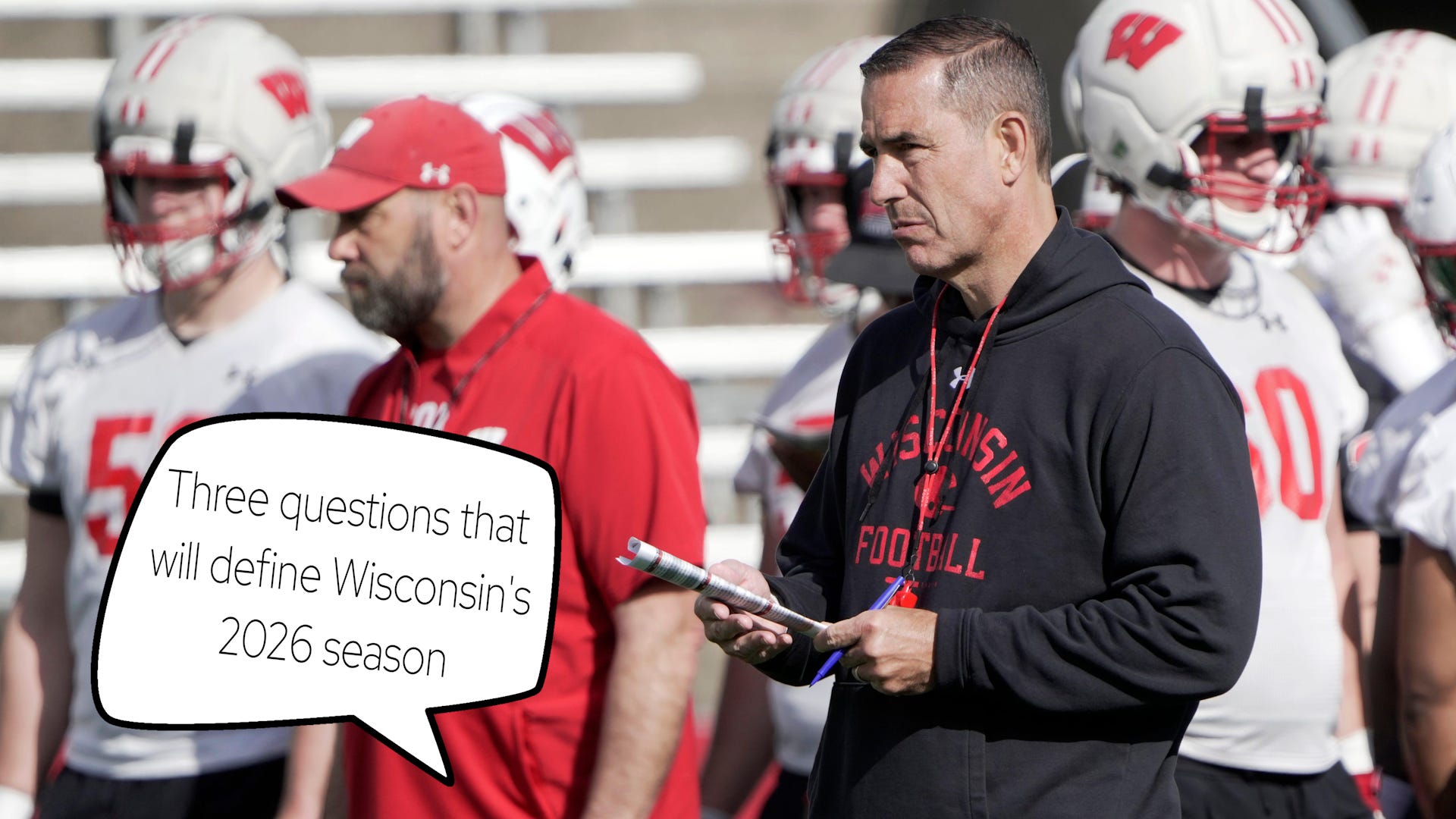
The roster has largely been rebuilt. Jeff Grimes is entering his second season. Colton Joseph appears to have established himself as the quarterback, and the Badgers have reshaped multiple position groups through recruiting and the transfer portal. The question is no longer whether Wisconsin is different than it was a year ago, but whether or not those changes have made the program better.
The program needs evidence that the foundation being built can finally translate into consistent success on Saturdays. As fall camp approaches three questions could determine whether the Badgers take a meaningful step forward in 2026.
Which position battles in fall camp have the greatest chance to change the entire season?
Every August certain competitions create headlines because they involve marquee positions, but the reality is that some battles have a much greater impact on the entire team than others. Positional battles can determine how the football is distributed during the season or serve and an indicator of a roster’s depth. They can alter a coach’s approach game planning from feeding a potential superstar or by trying to replicated one in the aggregate. Going into fall camp I feel that the coaching staff has three positions that not just by what the depth chart is can have a major impact on the team this season.
The wide receiver rotation is one of the most intriguing groups on the roster because the Badgers have accumulated more talent and versatility than they have had in recent seasons. Where have we heard this story before? The competition for the backup role will determine whether Wisconsin has reliable insurance behind Joseph because God knows that has become the most important roster spot on the team. And the interior offensive line rotation is not a headline grabbing battle but could be vital to keeping the engine running in a revamped Badgers’ offense.
The talk this off season so far has been “do we have a WR1?” A superstar that can take over a game and be the threat that defenses have to game plan against. That’s a luxury that I think unless a secret billionaire starts funding the football program and global warming turns Madison in a tropical paradise I don’t think we will ever see. So instead the offense need to be designed around a group of players who bring different strengths and can create problems in different ways.
True depth is when you can mix and match players based on their strengths to exploit defensive weaknesses, and while this roster may not have a first round draft pick there is potential for a solid group of role players. Tyrell Henry provides reliability and strong route running from the slot, Eugene Hilton Jr. gives Wisconsin a versatile weapon who can line up throughout the formation, and I don’t know if you’ve heard but Chris Brooks is the best blocking receiver on the roster. Newcomer Malachi Coleman brings significant physical upside while Zion Kearney has shown the ability to threaten defenses vertically, and Jaylon Domingeaux provides another physical option outside.
Six receivers with six individual skill sets that working together give the illusion of superstar hiding in plain sight. Depending on the matchup one receiver could lead the team in catches one week, while others could become the focal point the next. The goal is not to find one receiver who solves every problem; it is to create enough different threats that defenses cannot predict where the football is going.
The quarterback depth chart deserves attention. Not because it is a glimpse of the future of at the position or curiosity surrounding potential package using a player with a unique skill. Nope. It’s because we has Badgers’ fans have been conditioned to assume that the starter is going to get hurt eventually so we might as well get to know the backups. But where in the past we had a room that was built on this is the best we can do with what we have available and we need to make drastic changes to the offense for each QB now there is a sense of “this is what a Wisconsin QB is” and let’s build the offense around all of them.
Colton Joseph established himself as the starter during spring practice as he should have. At times there were some inconsistent moments, but that goes with a new QB in a new system with new coaches and teammates so that should not be viewed as unusual. Spring football often magnifies individual throws while ignoring the bigger developmental process. The more important takeaway was that Joseph became increasingly comfortable operating Jeff Grimes’ system, and his athletic ability fits naturally with the style of offense Wisconsin wants to run. Do by learning and learn by doing. QB1 is QB1.
The Badgers built this quarterback room with mobility and versatility in mind. It is refreshing to see a room with a common purpose. Joseph, Deuce Adams, Carter Smith, and Ryan Hopkins all bring different levels of athleticism, but still give the coaching staff the ability to maintain its offensive identity if and when the depth chart is tested. Praise Jeebus Joseph remains healthy and handles nearly every meaningful snap throughout the season. Let’s let the battle for QB2 to just be something the pundits talk about and not a preview of what’s to come.
Getting away from the ticket selling positions we get to a position battle that is both a battle for playing time and to be identifiable as one of the key pieces in the resurgence of the Wisconsin rushing attack. The interior offensive line is often overlook, but in and offense based around the wide zone you need guards who become mobile, agile, and hostile instead of just operating in a phone booth like in previous offenses. Inside linebackers may be playing B gap to B gap but if those gaps extend from sideline to sideline you can create real issues.
Position battles are all about rising up the depth chart, but creating true depth where you may be in an 1A/1B situations can be a real benefit. If there is a massive dropoff between the starter and the backup that can really effect playcalling and blocking schemes especially as a game wears on because of the wear and tear the players have to endure. So while it seem like Colin Cubberly and Emerson Mandell are pulling away don’t be surprised if you hear Blake Cherry or Stylz Blackmon’s names called because it allows Coach Mateos to have a little more of a balls to the wall attitude toward the blocking schemes knowing there be a massive dropoff if the backups come in. Having good depth allows for the occasional breather without changing your playcalling.
The one position I hope we never need to see the backup as is center. Austin Kawecki is perfect for this offense and honestly the less I hear him name the better. That’s great the Stylz took some snaps at center and looked solid. I just want a center who stays healthy, does his job and when we look back on this season we can say for the first time in years that we didn’t have to worry about the snap.
Competition brings the best out of a football player. So every battle is important, but not every battle completely changes the way a coaching staff will approach game planning because not every battle goes beyond who is where on the depth chart. True depth isn’t who you want to have on the field it is who can you not keep off the field.
If Wisconsin’s offense improves dramatically in 2026, what will be the biggest reason?
The easiest answer is Colton Joseph. Goodnight everyone.
If Wisconsin’s offense takes a significant step forward in 2026 the quarterback will receive much of the credit. That is how football has always worked. Quarterbacks are judged by wins, losses, efficiency, and production, and a major offensive turnaround almost always begins with improved quarterback play. And at a place like Wisconsin where we have made a habit of winning football games for 30 years with subpar QB play any improvement at the position is going to seem monumental. But focusing only on Joseph would miss the larger reason Wisconsin’s offense has a chance to improve.
Quarterbacks rarely develop in isolation because their success depends on the structure around them. The players protecting them, the weapons available to them, and whether the system puts them in positions where they can consistently succeed.
Last season was the perfect example of how to be terrible at offense. The offensive line struggled. The receivers lacked proven production, injuries affected continuity, and the quarterback position was what it was. All on top of a new offensive coordinator trying to cobble together an offense without the firepower to truly make it work. The biggest reason for optimism in 2026 is that the roster now looks far more like the offense Grimes wants to run. Year two in any system should look different from year one because he returning players understand expectations better while the coaches can spend less time teaching basic concepts. There is less installation and more repetition. The offense can expand because the foundation has already been established so the players are learning how to execute it faster and more consistently. That is key because Grimes’ offense relies heavily on timing, spacing, and decision-making.
There’s no doubt Colton Joseph is a better fit for the system than any of the previous Wisconsin quarterbacks. His athleticism changes the way defenses have to prepare because his mobility creates another element that must be accounted for on every snap. The threat of him running may be just as valuable as the number of designed carries because the defense has to respect the possibility that now every situation is a chance he could take off. And just like that the Badgers don’t need Joseph to become a running quarterback who constantly puts himself in danger. His athletic ability simply gives the offense another advantage. Sometimes the threat of movement creates opportunities before he ever leaves the pocket.
Now that the obvious is out of the way let’s get to the real answer. Everything Wisconsin wants to do offensively will be easier if the offensive line takes a step forward. It is the foundation that determines how much of the offensive playbook is available.
If Wisconsin’s offense improves dramatically in 2026 it will happen because the entire structure around the quarterback has improved. The scheme has continuity, the quarterbacks fit the system, the offensive line will become more reliable, and the team will finally begin to play the complementary football that has historically defined Wisconsin football.
Based on your observations from spring ball, how does this coaching staff’s approach to preparing the positional groups differ from coaches?
This question comes straight out of my YouTube comments so if you’ll allow me a quick plug for the ol’channel and if you like my content but don’t want to read head on over and subscribe. Every new member of a coaching staff is going to try and do things his way. It makes sense because everyone is different and coaches are not excluded. They have different personalities and different ways of communicating. People tend to forget that we only see a tiny piece of the coaching process. We watch a couple clips of practice and then try to make a judgement call on the work. But we don’t see what’s really going on because we don’t see what’s going on when the cameras aren’t rolling. We aren’t sitting in the meeting rooms, and wedon’t hear the corrections after film study.
That all being said for me it comes back to something I have said many times with the Dairy Raid. I love watching coaches coach. I enjoyed some of the coaches who aren’t here any more. I think AJ Blazek is a tremendous coach, a devoted teacher of the game, and really knows his craft. It’s why I’m still following him and I still study his teaching. It’s a shame he’s gone, but I think we hit a home run with Eric Mateos. I love watching him coach because you can really tell he REALLY cares about coaching offensive line. Ari Confesor brings a confidence that he projects to his players and that he wants them to carry as well. Coach Everett is connected with the history of this program and understands the standard that he needs to uphold and that hasn’t been met. And Coach Steeples has a smoothness and a clarity to his coaching that can only be matched by his own swagger. So from what I have seen yeah all these coaches are going to fit in great to the staff and I think our players in a real solid position heading into fall camp.
The position coach’s job isn’t just to know football. It’s to take what the coordinator wants and teach it so players don’t have to think about it on Saturdays. If a guard is worrying about his footwork instead of the linebacker scraping over the top, he’s already behind. The same goes for a receiver who’s thinking about his split instead of reading the coverage or a linebacker who’s processing his assignment instead of attacking downhill. That’s where coaching really shows up.
I also want to be careful and not turn every comparison into a debate about the old staff versus the new one. Like I said I believed the previous coaches could coach, and I believe this group can coach too. Changing coaches doesn’t magically solve every problem, just like keeping the same coaches doesn’t automatically create them. Sometimes everything lines up. When that happens, everybody suddenly starts talking about what a great coaching staff you have. Football has always been a little more complicated than giving one guy all the credit.
So if you’re asking what looked different this spring, my answer isn’t that one coach yelled louder or another ran a different drill, and honestly it’s not going to matter until we can see the actual outcome of their coaching. Has the new staff taken a different approach then in previous years? Yes of course, but only because there are so many new faces. At the end of the day football is football and there are only so many ways of interpreting “if you do A then B will happen”.