

Spring Forward: Building the 2026 Wisconsin Badgers Offense

I am a football doodler.
In the most literal sense of the phrase because any scrap of paper you find in my house has a decent chance of something football related scribble on it. My phone is no different with an overflowing folder of screenshots, clips, and notes from around the football internet. Anytime I come across anything noteworthy it will make made me pause long enough to try and translate it into the language of my own system.
Watching Wisconsin football this spring fed that habit. As fans all we got was a clip here, a drill there, or someone’s comments on a handful of snaps. From those fragments I try to do two things at once by first identify what is actually being presented, and extrapolate and scale up into what we saw could become. It’s part study, part guessing game but all in all a creative exercise that forces me to think critically beyond just “what did I see?”
Now I will fully admit that the conclusions I draw from all of this are filtered through my own self taught, heavily biased mind. I see what I want to see and connect dots based on my own understanding of football. From there I try to build an interpretation of how I would use those same ideas if I were designing the system myself. Of course that means some of my takeaways might not be aligned with what the coaching staff is actually installing.
But that to me is not a flaw in the process that’s the beauty of the game. Football is one of the few sports where the same information can be processed in completely different ways and still lead to success. Two coaches can watch the same clip, identify the same structure, and build entirely different answers around it. So what follows is my attempt to organize the spring into something coherent. I went through my notes, rewatched the clips, revisited the media reports, and pulled together anything that felt relevant to the direction of the Wisconsin offense. This is part observation, part projection, and part imagination.
“QBs running routes vs. air. Air Raid passing drill where 4-5 QBs run through the entire progression so every route gets a ball on time.”
As I have stated a couple of times during these spring wrap ups the simple act of running routes on air is a great way to build timing and muscle memory for both quarterbacks and pass catchers. Every play is built around the quarterback’s internal clock and physically manifested through his footwork.
A rhythm route is the route designed to be open when the QB hits the top of his drop. Is he open? Throw him the ball. He’s not? Then you’re on to the read route, which opens based on defensive reaction to the rhythm route, or simply because it takes longer to develop.
The rush and release routes serve two functions. In a pure progression, they can be your third or fourth options, but they can also function as built in hot or pressure answers. In a true progression concept, we work from the first read to the last. When you have multiple QBs who can throw all four or five routes in a concept, every receiver gets a ball, and you can really feel if there are any timing issues.
It’s a simple drill, but it’s a great way to start a practice.
“Hopkins, Smith, Adams working RPO footwork to throw sticks”
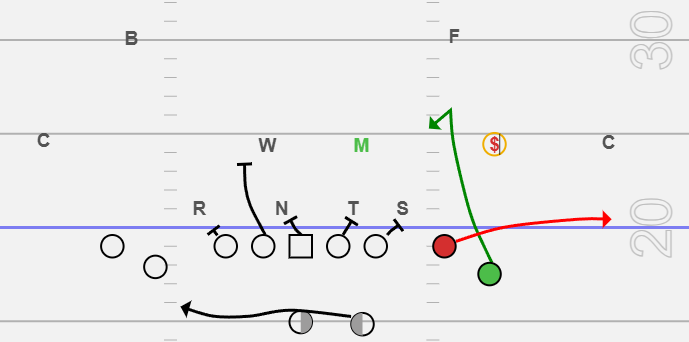
I think RPOs get a bad rap these days because many people don’t understand the difference between play action and an RPO/package play. More egregiously it’s often viewed as a dumbed down version of the passing game. And I suppose there is some truth to that but only in the sense that it doesn’t take a rocket scientist to put a defense in conflict of assignment.
At its core all you’re really saying is “I have a run play I want to run, but I don’t have enough blockers to run it successfully. How can I eliminate defenders to make the run game more efficient?”
In this example, we’re running outside zone with a stick/flat concept as the read. If the MIKE linebacker flows with the run, we hit the stick route behind him. If he doesn’t react or reacts slowly we hand the ball off and stay on schedule with the run.
The tight end or slot in the flat serves a dual purpose: he’s a safety valve if the throw is there, and he also helps hold or widen the box safety, preventing him from inserting into the run fit.
“Colton Joseph working his progression on a quick drop to hit Tyrell Henry across the formation in the EZ. Guessing they were probably running a variant of Y Cross from a 3x1”
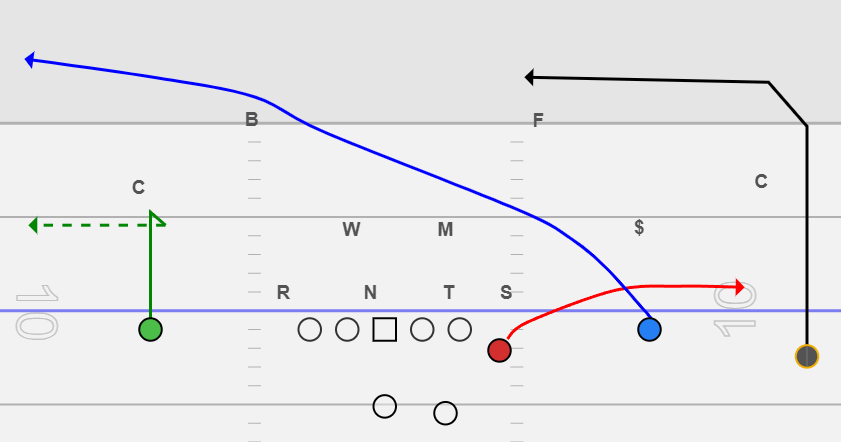
It has been well documented that I have a certain disdain for the all or nothing nature of the 2025 Wisconsin passing game. Either we were running screens, slow developing play action concepts into nothing, or just throwing up a prayer.
What was often neglected was the part of the field that actually unlocks those types of plays: the middle of the field and the intermediate route space that ties everything together. Colton Joseph also came from an offense that seemed to operate with a similar mindset, just with a different structure. The screens were replaced with RPOs, and the dropback passing game appeared to lean heavily on curls and crossers working in and around vertical route structures.
“Colton semi rolls off of play action to again hit Henry coming across the formation (Yankee?)”
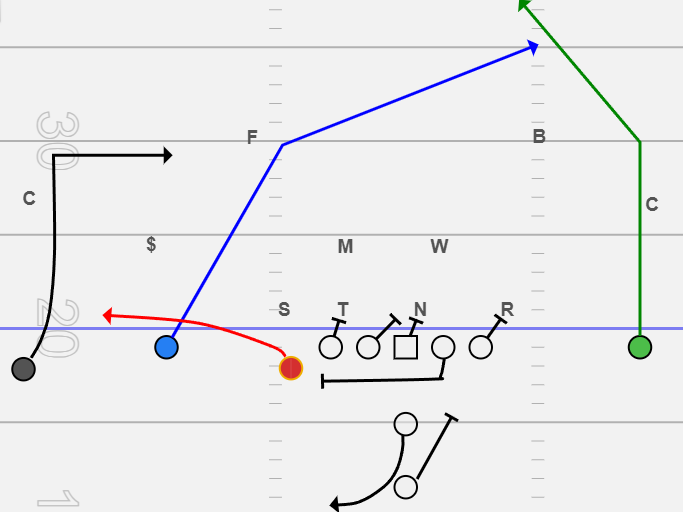
An easy way to build a fundamentally sound passing game is to work with route concepts that are effective in both traditional dropbacks and play action. The Yankee concept is commonly used as a play action shot play designed to punish aggressive safeties. Heavy run action can bring safeties down into the box, while the post, cross, and dig route combination puts the remaining single high safety in conflict.
But even in a straight dropback the same routes create both high low and inside out stress that opens up shot opportunities while still maintaining built in intermediate and short checkdown options.
“Hard to tell the exact formation/routes but Harris in what appears to be the slot and Dupree going direct to the flat could indicate possibly a jet sweep action before the rollout”
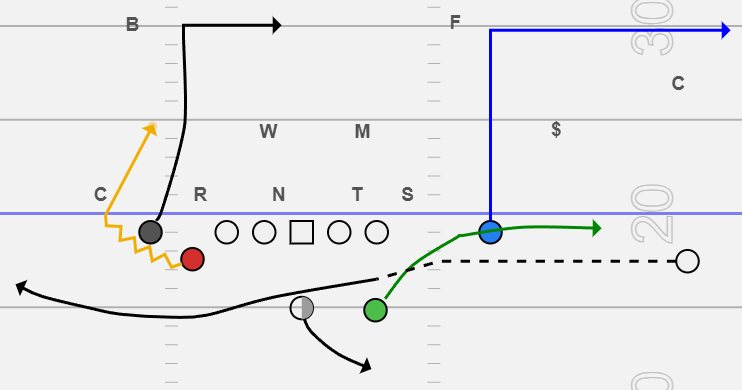
The play action game cannot be built entirely on slow developing shot plays. Often you need action and routes that hit just as quickly as the run concept they are built off of.
A simple way to do that is with a variation of a play many of us who grew up in the Wing-T could run in our sleep, the waggle. The play starts with sweep action, and for the Badgers that sweep action comes in the form of a jet sweep from an outside receiver in a condensed formation.
The routes are structured as a basic flood concept, but what I like here is how the formation and the running back’s route work together to create space over the top for the tight end running the deep out.
“Halfline scheme vs. scheme sees the offense run center/tackle pin & pull with Nate Palmer following behind C Logan Powell”
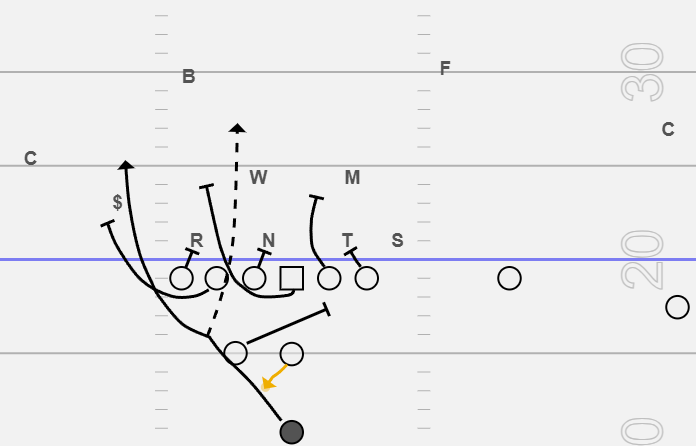
When running a zone heavy rushing attack it is important to incorporate complementary gap schemes. Defenders become conditioned to pursue laterally so you need to have the ability to exploit that aggression to create and define interior gaps.
The pin and pull creates favorable blocking angles both on the perimeter and on the cutback. A byproduct of a functioning gap scheme is forcing the defense to play with more gap control discipline and therefore you create additional stress points and more answers within the zone run game.
This is complementary football.
“The flop IZ read that we ran once with Carter Smith and Colton Joseph ran very successfully at ODU makes an appearance”
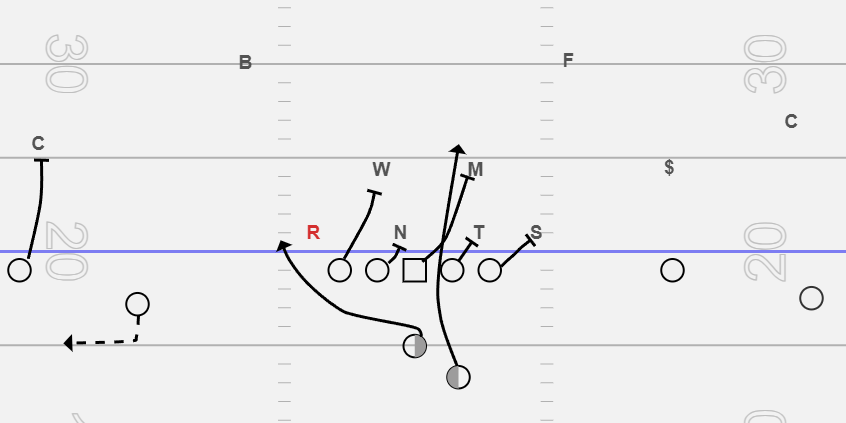
There are two general categories that most read based run plays fall into. First you have the old school/same side reads. From traditional veer to speed option looks the backfield action is moving toward the read defender, creating a more direct conflict in front of him.
Then you get into the “modern” zone read, where the backfield action crosses the quarterback and the read is typically a backside defender. This is where you start to see more horizontal stress and late manipulation of the second level.
The flop read is a “best of both worlds” type of concept. It gives you same side flow with a read that still lives on a backside defender. What I really like about this play is how clean it is structurally while still creating real conflict of assignment through simple blocking rules and backfield action.
Tag a bubble screen on the read side slot, and now you’re punishing any defender who gets too aggressive fitting the alley.
“Mesh out of a 3 receiver set. No RBs so potentially this could be used out of a 2 back set eventually”
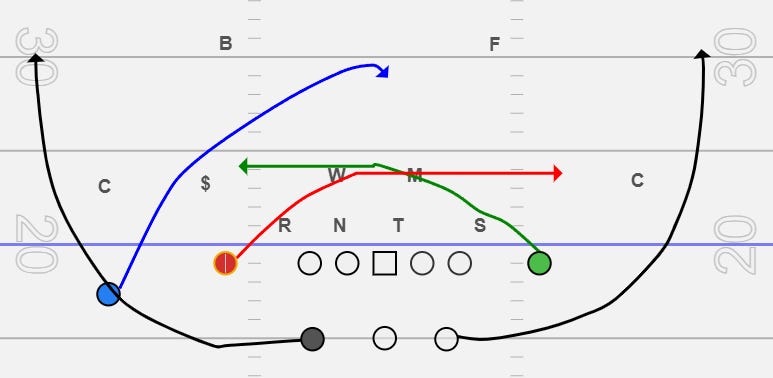
One of the key selling points for Colton Joseph was the offense Coach Grimes ran at BYU combining NFL style wide zone principles with vertical concepts and Air Raid spacing. If you go back and watch that BYU film, you see mesh... a lot of mesh. And for good reason.
Mesh is one of the most versatile concepts in football. Whether it’s formation variation, motion, or protection adjustments, the answers are already built into the concept you’re just changing the presentation.
What makes it so effective is its simplicity underneath the surface. You’re stressing defenders horizontally, creating natural rubs, and all while keeping the quarterback’s read clean and repeatable.
Somewhere, Mike Leach is smiling.
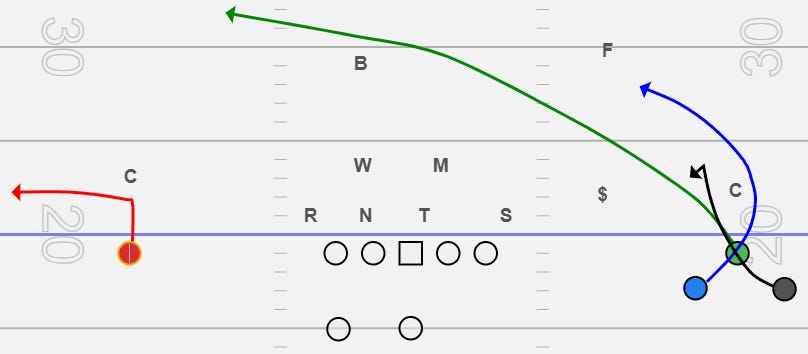
“Y Cross H Follow out of a 3x1 bunch set”
Pucker up, sweater vests you’re not not going to like where this is going.
Building off the idea of using slot receivers to run intermediate crossing routes a great way to prevent defenders from jumping those routes is to use the “wake” of the crossing receiver to create space for a trailing route behind it.
An H follow concept does exactly that, using a switch release stem to create natural separation for the #3 receiver (the H) to trail the #2 receiver (the Y). By pushing his route deeper than the initial cross the H can also create a high low conflict for any potential flat defender forcing him to choose between underneath support and intermediate leverage.
Using a switch release with a Y cross has been a staple of the Phil Longo offense one he ran successfully everywhere...except Wisconsin. So there’s that.
“Another potential go to guy emerging is Tyrell Henry playing in the slot. Colton laid up a nice ball in between three defenders and hit Tyrell in the end zone. Dagger?”
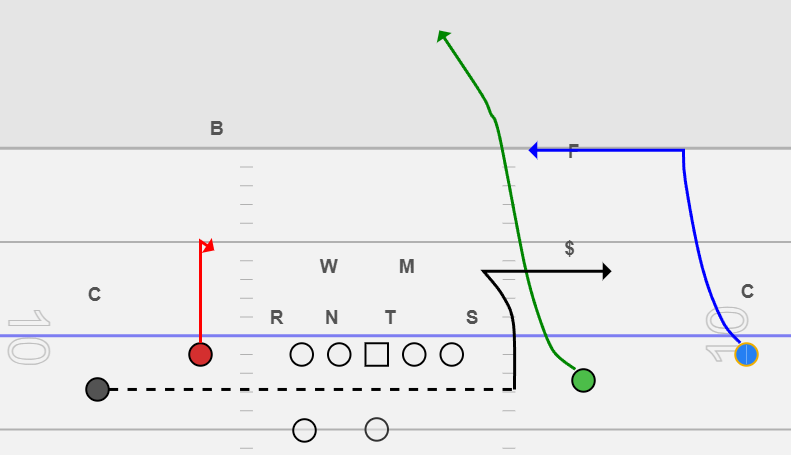
So far, the new look passing game has been focusing heavily on getting the slots involved in the intermediate passing game, and the dagger concept builds toward and expands on that idea.
By running a player like Tyrell Henry on an inside release up the seam you immediately threaten the safety vertically. But since we’ve been working underneath him so much that safety can get a little flat footed, which opens up opportunities over the top.
By holding the safety inside and vertically you create a natural window for the Z receiver to run the dig route and occupy the vacated space. The result is both high low and inside out stress on the coverage. The dagger concept can be run from both a quick three step drop and off play action, and there are multiple variations you can build off the outside receivers beyond just the seam and dig combination.
It’s always fun to see passing concepts that create answers simply, efficiently, and with built in conflict at every level of the defense.
As a final disclaimer it is important to remember that everything discussed here is based on a handful of short practice clips, photos, media observations, and my own interpretation of what I think I am seeing. I am not sitting in offensive meetings or have access to the playbook. For all I know half of these concepts are one offs, drill work, or something completely different than what I have described. For me that’s part of the fun.
Football is a giant puzzle, and spring practice only gives us a few pieces. The challenge is taking those pieces and trying to imagine what the completed picture might look like. What stood out to me this spring wasn’t necessarily any individual play or route concept. It was the possibility of an offense becoming more interconnected with concepts that build off one another. The best offenses aren’t collections of plays they are collections of answers.
Whether Wisconsin is ultimately heading in the direction I’ve outlined remains to be seen. My conclusions could be completely different from what the coaching staff actually intends. But based on the limited information available, there appear to be signs of an offense continuing to grow, expand, and layer complementary concepts together. And for someone who can’t stop doodling football plays in notebooks, on scraps of paper, or in the notes app at two in the morning, that’s enough to keep the imagination running until kickoff.